
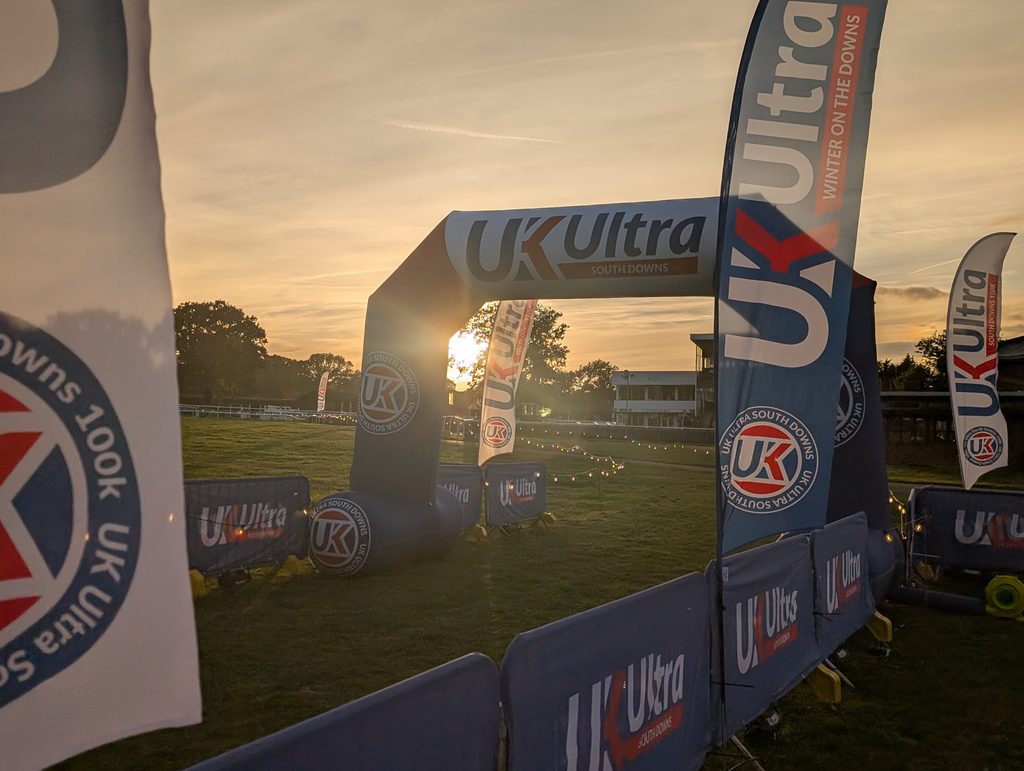
Most Saturday evenings involve settling onto the sofa; standing on a racecourse paddock at twilight waiting to run fifty kilometres through the dark feels like a deliberate act of mischief. My watch didn’t share the enthusiasm. Since early September it had been persistently flashing up a sub-optimal HRV, quietly hinting that an early night was the sensible option. It was also my first time standing on a start line entirely on my own. No support crew, no familiar faces waiting at the aid stations, just my own pack and whatever lay between Plumpton and the high chalk.
First Stride Out
There was a joint start with the half-marathon field which is an exercise in enforced patience, jogging a few paces, braking at a kissing gate, and holding stiles for strangers. Once the gradient bit, the traffic cleared and the legs settled just as the sun slipped over the rim of the Weald. Then came the trees at kilometre five. One click of the headtorch switch, and the entire horizon shrank to five feet of stark, highlighted chalk and gravel.
Once the headtorch was on and the pack strung out into single file, the erratic stops and starts finally vanished. My cadence locked into an even rhythm, and the heart rate which had spiked into the 150s during those early stiles and bottlenecks now settled down into a steady, predictable hum in the low-130s. Despite the sticky autumnal air and the watch’s earlier warnings, the engine was running cleanly. Out on the open chalk of the ridge, the race became purely about foot placement, scanning the pool of white light for sunken flint and letting the kilometres tick by in quiet concentration until the trees around Falmer parted.
The Island at Falmer
The University checkpoint appeared out of the dark like a well-lit island. I’ve concluded that aid stations when you’re on your own are dangerous places if you linger; it’s far too easy to stand under the strip lights, eye up a table of biscuits you don’t need, and let the brain start negotiating. Without a crew waiting, the routine had to be simple: flasks ready, cold water in, a quick nod of thanks to the marshals, and straight back out into the black before the rhythm could slip away. Two minutes, cake successfully avoided, and the legs still feeling strong as I turned back into the dark.
The Fictitious Hill and the Barn
Confidence in the dark is remarkably contagious. Roughly halfway through, I bought entirely into the illusion that the headtorches ahead had a plan, following them straight off the course and up an excruciating climb that felt like a sheer wall. It took several burning minutes of heavy breathing and screaming calves before the collective delusion broke and we realised we were just four or five tired runners assaulting an entirely fictitious hill.
So, around we turned, scrambled back down, and eventually found our way back to the course and into Aid Station 2. This one was tucked inside an old barn with friendly volunteers. I had intended another quick turnaround-bottles out, water filled, straight back into the night. Instead, discipline dissolved into a Marmite sandwich and a handful of Pretzels under the convenient guise of replacing salt. I was reminded of some wise words from a training partner: ‘it’s just a series of 10ks with a picnic in between.’ She wasn’t wrong; the spread on display was impressive.
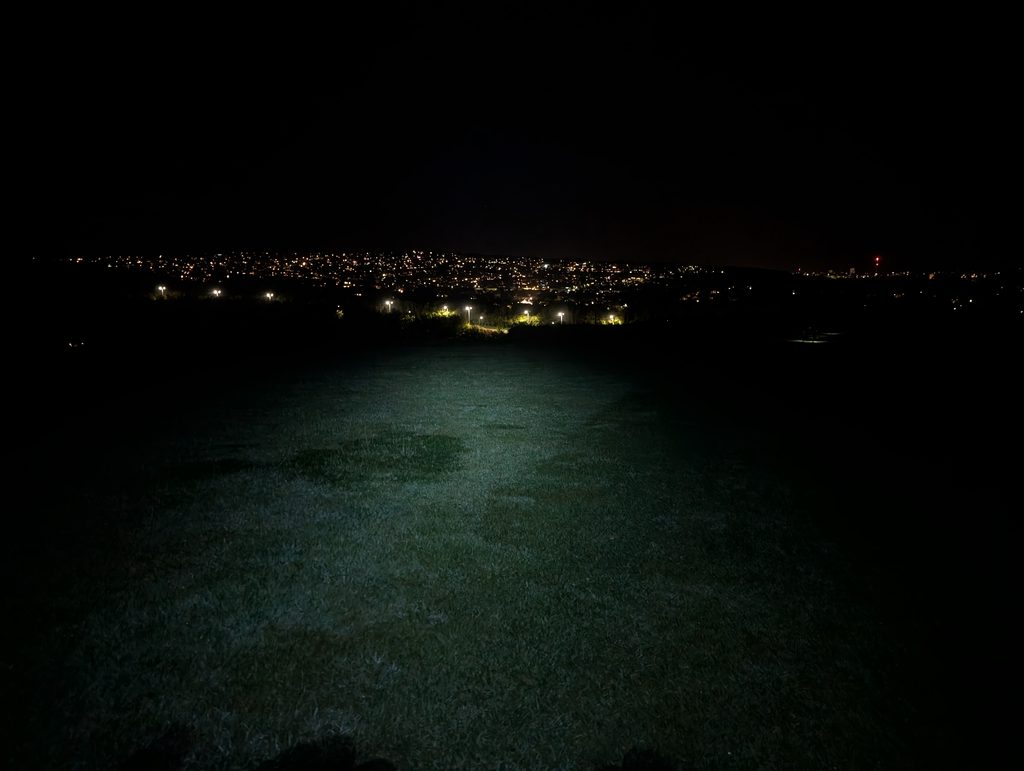
Stepping out of the warmth of Aid 2, the light from the barn pooled across the yard behind me like a proper beacon of comfort. It made turning your back on it and heading into the black feel twice as cold. The loop out towards Devils Dyke quickly closed in. By day the Dyke is all big views and tourists leaning into the channel breeze, but at midnight the earth just fell away outside the headtorch beam. Skirting the ramparts of the old hill fort, there was no real sense of scale. Just the crunch of chalk under your feet, the occasional flash of sheep eyes in the dark, and the solitary job of ticking off the kilometres.
There is a very particular brand of dark humour in having to pay twice for the same hill, only this time on tired legs and knowing full well how much it was going to sting.
Then you drop back down into the valley, only to find yourself standing right back in the same barn. Leaving Aid 3 meant facing the exact climb we had taken by mistake an hour earlier. There is a very particular brand of dark humour in having to pay twice for the same hill, only this time on tired legs and knowing full well how much it was going to sting.
Over the top and heading towards Pyecombe, the race settled into an unspoken game of tag. You would catch someone on a climb, get stuck behind a red light at a kissing gate, then pull away again on the descent. No words exchanged, just that quiet understanding between people running the exact same battery down.
By the time the track dropped down towards Aid 4, running had turned into an honest trundle. The engine was still ticking over, but the novelty had completely worn off. It was just heavy, mechanical work, carrying all that bonus elevation and trying not to listen to the quiet arithmetic in my head about how much night was left. Seeing the lights of the final checkpoint cut through the dark was pure relief. A quick reset, a deep breath, and just the final stretch between the downs and home.
The Final Push
Leaving Aid 4, the route finally leveled out. There was one last climb left on the profile, but after what the night had already thrown at the quads, it was a mere bump rather than a battle. Dropping off the high open chalk of the downs, the trail wound down into deserted rural paths and dark country lanes. It was strange slipping past quiet houses with drawn curtains, acutely aware of the warmth and sleep on the other side of the brickwork while I trudged by out in the cold.
Before long, the turns started to look familiar. The lane swung round, and there across the dark were the floodlights of the racecourse. With the finish line finally real, the legs found a gear that had been completely absent ten minutes earlier. I dug in, found a proper stride for the final kilometre, and swung into the paddock at two in the morning to collect the medal and a well-earned t-shirt.
The 2:00 AM Debrief
Looking at the watch, the night made strange reading: twenty minutes off my personal best, even with 1,200 metres of climbing and some accidental bonus mileage. The event itself was cracking, faultlessly organized, brilliantly supported, and with marshals who were exceptional from start to finish.
My only real gripe was the gate near the barn. As you turn to latch it behind you, your headtorch catches a course arrow pointing straight up the hill, and on tired eyes it looks convincing enough to lure you right into trouble. Had we not bumped into another runner who spotted the error early, a DQ could easily have been the outcome.
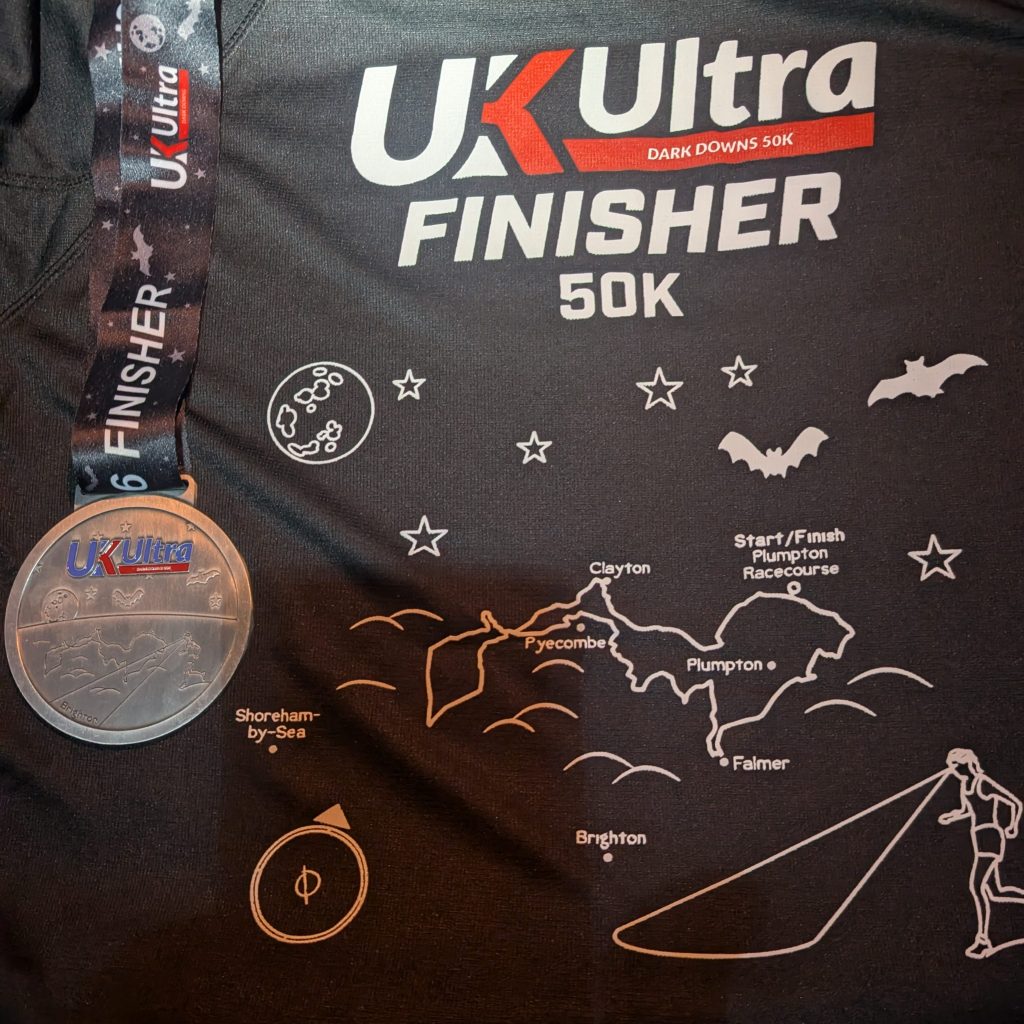
Still, the real takeaway wasn’t the detour; it was the head game. That dead patch between thirty and forty kilometres, where the initial novelty has evaporated and the doubts start whispering, needs better management. But standing in the cold paddock at two in the morning, holding a medal and knowing the engine held up, it was hard to argue with the result.
Leave a Reply